Bernie Ohls
The Big SleepBernie Ohls, the district attorney’s chief investigator, is Philip Marlowe’s principal link to the official investigation in The Big Sleep. He brings Marlowe into the Sternwood affair, checks the cases surrounding its deaths and disappearances, and helps distinguish a plausible reconstruction from what the police can actually establish. His role gives the novel a practical view of law enforcement: informed, resourceful, and constrained by evidence and the stories people tell about it.
Identity and Introduction
Ohls first appears as the investigator who gave Marlowe the lead to General Guy Sternwood. The morning after Marlowe’s visit to Arthur Gwynn Geiger’s house, Ohls calls him; their familiar exchange begins casually, but the call soon becomes a channel into the official inquiry. Ohls is not simply an outside authority. He already has a working relationship with Marlowe and can draw him into the police account while listening to what the private detective has found.
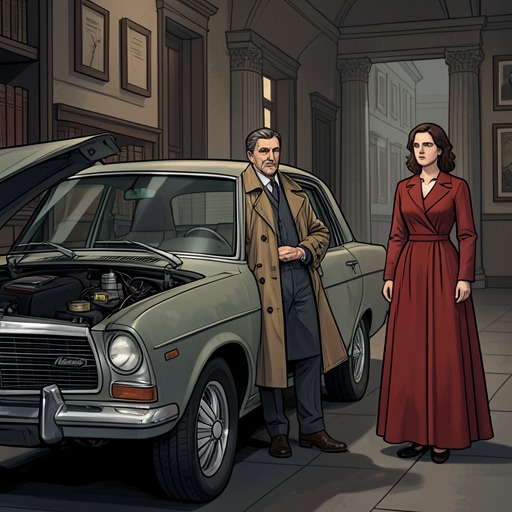
When Marlowe visits him at the Hall of Justice, Ohls is in a small office among the district attorney’s investigators. His desk is nearly bare, and he sits with a foot on it. He is medium-sized, blondish, and unremarkable in appearance, with stiff white eyebrows, calm eyes, and well-kept teeth. Marlowe knows, however, that Ohls has killed nine men, three while undercover or believed to be undercover. The contrast between an ordinary street appearance and a violent professional history gives his calm manner an edge without making him theatrically imposing.
Working with Marlowe
Ohls’s investigative work repeatedly supplies context that Marlowe cannot get from the crime scenes alone. At the Lido Fish Pier, he hears the account of how Owen Taylor’s car went through the broken barrier and enters the water. The timing is reconstructed from physical circumstances: the wood was dry inside after the rain stopped, the tide limited how far the car could have drifted, and Taylor’s body was found under the water the next morning. The account places the death around ten the previous night, perhaps as early as half past nine. It is an example of Ohls’s world: circumstances and traces narrow the time, but do not by themselves explain motive or settle every question.
Ohls also gives Marlowe Taylor’s history with the Sternwoods. About a year earlier, Taylor had been arrested under the Mann Act after taking Carmen Sternwood to Yuma. Vivian Regan brought them back, and Taylor was jailed; the next day she appealed to the district attorney, saying Taylor had meant to marry Carmen and Carmen had only wanted to go out and enjoy herself. Taylor was released and later returned to work for the family. A subsequent fingerprint report revealed an Indiana attempted-robbery conviction, but the Sternwoods kept him in their employ. Ohls’s account links Taylor’s official record to the family’s private decisions and shows how much relevant information can remain outside the initial police narrative.
Marlowe can also call Ohls directly for information. After finding Carol Lundgren in Geiger’s house, Marlowe phones Ohls at home to ask whether the police found a revolver on Taylor. Ohls answers cautiously that the question falls under police business. The exchange makes clear that their familiarity does not erase the boundary between a private detective’s inquiry and official information. Ohls can be a conduit, but he does not treat every request as automatically open to Marlowe.
Evidence, Judgment, and Official Accounts
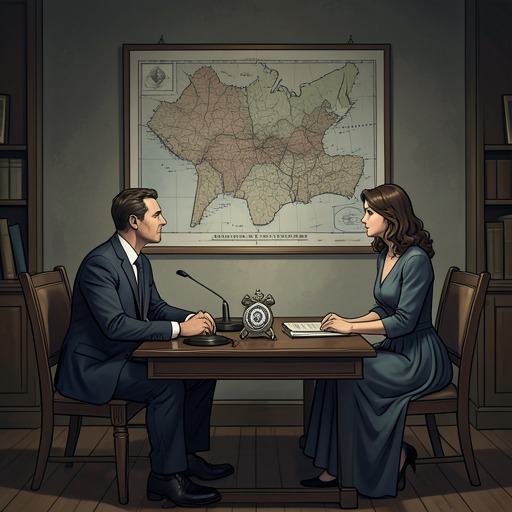
In his discussion with Taggart Wilde, Ohls is part of an argument over what can be inferred from Taylor’s death and the evidence surrounding Geiger’s murder. Wilde points out that even if the murder weapon were found on Taylor or in the car, that would not prove Taylor fired it: the gun could have been planted by Joe Brody. Marlowe answers that such a scenario is physically possible but morally implausible, given Brody’s character, actions, and commercial interest in Geiger’s racket. Taylor, by contrast, had jealousy, motive, and access to a family car. The exchange separates a chain of circumstantial reasoning from proof that would survive alternative explanations; it also shows the officials weighing Marlowe’s reconstruction rather than simply adopting it.
Ohls’s involvement continues after Marlowe’s confrontation with Lash Canino at the Realito hideout. In a feverish, repetitive recollection, Marlowe imagines having driven back to Los Angeles with Mona Mars and explained the killing to Wilde, Ohls, and a sheriff’s-office investigator. The account includes the examination of Harry Jones’s body at the Fulwider Building, where a fingerprint man is reminded to check the transom latch and finds Canino’s thumbprint. The sequence is presented as Marlowe’s looping mental replay, not as a separate, fully narrated investigation; within it, Ohls is one of the officials who hears the case and acts on the reported evidence.
That recollection also places Ohls at the official handling of the case’s aftermath. After Marlowe signs a typed statement, Eddie Mars arrives and greets Mona, who does not respond. Once the others have left, Wilde warns Marlowe that another fast move will bring consequences regardless of whose feelings are hurt. Ohls has helped bring Marlowe’s account into official channels, but the recollection makes clear that institutional cooperation is not the same as unqualified approval. The investigation produces a statement and a traceable piece of evidence, while leaving tension between Marlowe’s methods and Wilde’s authority.
Role in the Wider Mystery
Ohls’s position gives him access to the institutional history behind the novel’s private scandals, but that access does not mean the police already understand the central crime. When the case turns to Rusty Regan’s disappearance, Captain Gregory tells Marlowe that Regan vanished on September 16. The chauffeur was off that day, and nobody saw Regan take his car. Four days later the car was found in a garage at the Casa de Oro; the police could not identify who had put it there. Gregory also describes the investigation into the tenants and the report that a man resembling Regan had been seen with Eddie Mars’s missing wife, while acknowledging that the identification was uncertain. This account belongs to Gregory, not Ohls, but it establishes the limits of the police picture within which Ohls and Marlowe operate: the car and the possible sighting sustain a disappearance story without proving it.
The novel eventually reveals why the official uncertainty matters. Marlowe tells Vivian that on the day Regan disappeared, he took Carmen to the old wells to teach her to shoot. She turned the gun toward Regan and shot him instead of the target. Vivian replies that Marlowe cannot prove his account of Carmen’s attempt to shoot him; Marlowe distinguishes that unprovable episode from the earlier truth he has pieced together. Ohls is not the source of this revelation, but his work belongs to the investigative world that has accumulated clues without uncovering the decisive fact. The contrast between a police file and Marlowe’s final reconstruction defines the limits of the official narrative.
Ohls therefore serves as both an ally and a measure of the law’s reach. He can provide history, test a detective’s account, and participate in the formal response to violence; he cannot make uncertain evidence conclusive or force the family’s secret into the open. The novel’s investigation moves between physical traces, police records, private inference, and deliberate concealment. Ohls stands at the point where those versions meet, helping the case proceed while exposing how much remains outside what the authorities can establish.